
A Reality Many Students Discover Too Late
Every year, thousands of students receive the same email:
“We regret to inform you that your application was unsuccessful.”
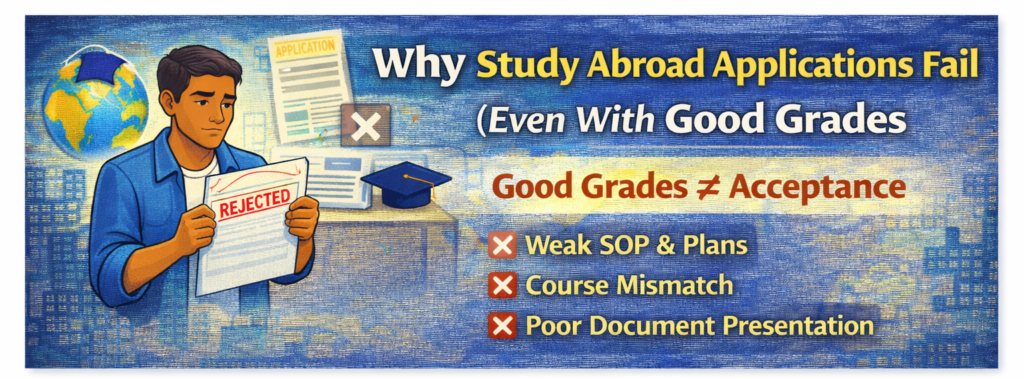
What makes it painful is not just the rejection —
it is the confusion.
Because many of these students:
- Have good grades
- Met the academic requirements
- Followed “what others did”
- Paid application fees
- Submitted documents on time
Yet, they were still rejected.
This article explains why study abroad applications fail even with good grades, using real patterns seen across international admissions, not assumptions or marketing promises.
If you are planning to study abroad — or have already been rejected — this guide will help you understand what actually matters and how to avoid repeating costly mistakes.
Why Good Grades Are Not Enough for Study Abroad
One of the biggest misconceptions in international education is this:
“If my grades are strong, admission is guaranteed.”
That is not how universities evaluate applications.
Grades are only a baseline filter.
Once you meet the minimum academic requirement, other factors decide everything.
Universities assess:
- Risk
- Intent
- Clarity
- Alignment
- Documentation strength
Two students can have the same GPA — and one gets admitted while the other is rejected.
The difference is not intelligence.
It is application strategy.
The Real Reasons Study Abroad Applications Fail
1. Weak or Generic Statement of Purpose (SOP)
This is the number one reason students with good grades get rejected.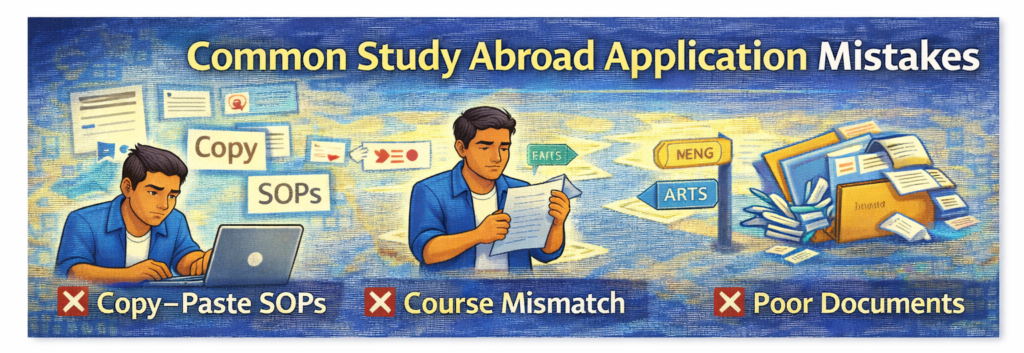
A weak SOP usually:
- Repeats the CV
- Uses generic phrases copied online
- Lacks clear academic direction
- Does not explain why the course or country
- Shows no long-term plan
Admissions officers read thousands of SOPs.
They can instantly detect:
- Copy-paste templates
- Fake passion
- Confused goals
A good SOP answers one core question clearly:
“Why should we invest in this student?”
If your SOP does not answer that convincingly, grades will not save you.
2. Course and Career Mismatch
Another silent rejection trigger is misalignment.
Examples:
- A business graduate applying for pure computer science without explanation
- A science student choosing an unrelated humanities course
- Random course selection based on “what people apply for”
Universities ask:
- Does this course make sense for this student?
- Is there a logical academic progression?
- Will the student complete the program successfully?
If the answer is unclear, the application is seen as high risk.
Good grades cannot justify a confused academic direction.
3. Poor Documentation Quality
Many rejections are not about what you submit — but how you submit it.
Common documentation problems:
- Inconsistent dates
- Poorly scanned documents
- Missing explanations for gaps
- Weak recommendation letters
- Incorrect formatting
Admissions teams interpret poor documentation as:
- Carelessness
- Lack of seriousness
- Potential visa risk
Even small errors create doubt.
4. Lack of Clear Motivation for the Country or Institution
Universities want students who:
- Understand their education system
- Chose the institution intentionally
- Are not just “trying their luck”
Applications fail when:
- Country choice is not explained
- Institution research is shallow
- SOP sounds like mass application text
Strong applications show:
- Why this country
- Why this institution
- Why this program
Clarity reduces risk.
Confusion increases rejection.
5. Financial and Credibility Concerns
Even academically strong students get rejected due to:
- Weak financial explanation
- Inconsistent sponsor information
- Unclear funding sources
- Unrealistic financial plans
Universities assess:
- Ability to sustain study
- Likelihood of dropout
- Visa approval probability
If finances are unclear, the application becomes risky.
A Pattern Seen Across Rejections
Over time, a clear pattern emerges:
- Strong grades + weak narrative = rejection
- Average grades + strong clarity = admission
This is not unfairness.
It is risk management.
Universities do not admit grades.
They admit students.
What Actually Works for Study Abroad Success
1. Strategic Course Selection
Choose courses that:
- Build logically on past education
- Support your career direction
- Can be explained clearly in writing
Random choices cost admissions chances.
2. Honest, Structured SOP Writing
Effective SOPs:
- Explain motivation simply
- Show academic growth
- Connect past, present, and future
- Avoid exaggeration
- Avoid copying
Clarity beats creativity.
3. Clean, Consistent Documentation
Before submission:
- Cross-check all dates
- Review formatting
- Ensure consistency across documents
- Explain gaps clearly
Professional presentation signals seriousness.
4. Early Planning (Not Last-Minute Applications)
Many failed applications are rushed.
Early preparation allows:
- Better SOP drafts
- Proper document review
- Course research
- Correction of weak areas
Time improves quality.
Case Study: Two Students, Same Grades — Different Outcomes
Student A
- Strong GPA
- Generic SOP
- Random course choice
- Poor explanation of goals
➡️ Rejected
Student B
- Similar GPA
- Clear SOP
- Logical course selection
- Clean documentation
➡️ Admitted
The difference was strategy, not intelligence.
How HakBizz Approaches Study Abroad Applications
At HakBizz, applications are treated as structured projects, not document submissions.
We focus on:
- Academic alignment
- SOP clarity
- Risk reduction
- Ethical guidance
- Long-term planning
👉 (5 Templates every travelers need for huddle free)
Frequently Asked Questions
Why do study abroad applications fail even with good grades?
Because universities assess risk, motivation, clarity, and documentation — not grades alone.
Is SOP more important than GPA?
Once GPA meets requirements, SOP often becomes the deciding factor.
Can students reapply after rejection?
Yes — and many succeed when mistakes are corrected strategically.
Final Thought
Good grades open the door.
But clarity decides who enters.
If your study abroad application failed — or you want to avoid failure — do not focus only on marks.
Focus on:
- Alignment
- Explanation
- Preparation
- Honesty
That is what actually works.